
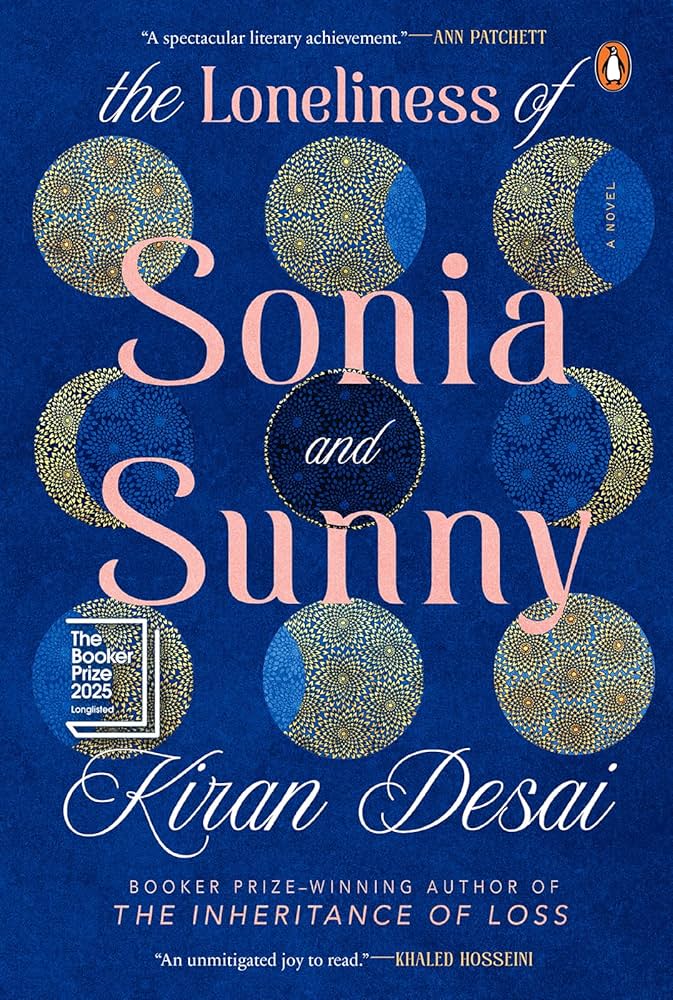
The Loneliness of Sonia and Sunny
| Published | 2025-09-23 |
| Series | Standalone |
| Genre | Literary Fiction, Historical Fiction |
| Language | English |
| Publisher | Hogarth Press |
| ISBN-10 | 0307700151 |
| ISBN-13 | 978-0307700155 |
📝Honest Review
This is a very large book in every sense. It is large in its page count, large in its ambition, large in its cast, large in the range of experience it encompasses and the number of ideas it carries. It moves between New York and India, between the 1990s and the early 2000s, between Sonia's family and Sunny's family and the extended, complicated world each of them comes from. It shifts registers with remarkable fluency, from comedy to grief to philosophical reflection to something approaching magical realism, sometimes within a single scene. It is the kind of novel that demands the reader's full attention and rewards it extravagantly.
The love story at the center of the book is real and felt and necessary, but calling it a love story the way you would call a lesser novel a love story does the book a disservice. Sonia and Sunny are people first and lovers second, and Desai is interested in all of them, in their pasts and their families and their failures and their specific, individual ways of moving through a world that keeps producing new demands they were not quite prepared for. Their romance is not the point of the novel so much as it is the lens through which the novel's actual subjects become visible: the cost of immigration, the way class moves with people across borders and continues to organize their experience in new countries, the particular loneliness of belonging fully to nowhere, the relationship between art and exploitation, the weight of family history on people who never asked to carry it.
What is most immediately striking is the prose. Desai writes with a density and a precision that requires slower reading than most contemporary literary fiction, not because it is difficult but because it is doing so much at once that rushing through it means missing the texture that makes it remarkable. A sentence about a train journey in the 1990s India will carry inside it a whole social history, a family memory, a joke, and an observation about desire, all at once, without feeling strained. That kind of writing is extremely rare. It takes time to produce, which may explain the nineteen years between novels, and it takes time to read, which the book consistently and unapologetically demands.
The novel is also genuinely funny in ways that are not incidental to its larger purposes. Sunny's family and its endless internal warfare, conducted with the particular theatrical intensity of people who would rather fight than admit they love each other, is written with a comedic sharpness that would not be out of place in the best Salman Rushdie. Sonia's relationships with a series of artists who mistake her as raw material for their work rather than a person with her own interiority is skewered with dry, knowing precision. Desai holds her comedy and her grief in the same hand without letting one undercut the other, which is the hardest thing to do in fiction and one of the things that separates truly accomplished novelists from merely talented ones.
The novel's weaknesses, such as they are, are the weaknesses of ambition rather than of failure. At nearly seven hundred pages it inevitably has passages that work harder than others to sustain the reader's engagement, and the structural decision to move between so many characters and timelines occasionally creates a sense of dispersal that the central love story has to work hard to anchor. Some readers will find the digressions, including an extended engagement with Indian literary culture and the question of what it means to write about India in English for a global audience, more interesting than others. Desai is making a case for the novel as a form capable of holding all of this, and she wins that argument, but not every page of the winning is equally compulsive.
Nineteen years is a long time to wait for a book. The Loneliness of Sonia and Sunny is a book worth waiting nineteen years for. That is not a sentence I expected to write when I started it, and the fact that I can write it without qualification at the end is its own kind of testimony.
Summary:
Sonia and Sunny are both young, both Indian, both standing at the edges of lives that have not quite taken the shape they imagined. Sonia has just finished her studies in Vermont and returned to India, carrying with her the damage of a relationship with an older artist who she fears has somehow cursed her. Sunny is a struggling journalist who has recently moved to New York City, trying to escape an imperious mother and the particular violence of a family that cannot stop fighting with itself. Their grandparents had once tried to match them, clumsily, and that interference had poisoned any chance of a natural beginning. Then, on an overnight train in India, they see each other again, and something starts. What follows is a novel of nearly seven hundred pages that moves between continents and decades and generations, tracing the long, difficult, occasionally hilarious, and deeply human search of two people for happiness in a world organized to make that search as complicated as possible.
✅ What I Liked
The prose is among the most accomplished in recent literary fiction, dense and precise and full of ideas without ever feeling labored. The range of the novel, its ability to hold comedy and grief and political observation and family saga and love story simultaneously, is extraordinary. The Booker Prize judges were right to describe it as the most ambitious and accomplished work Desai has produced, and given what she produced in The Inheritance of Loss, that is significant praise. The portrait of Indian families navigating the specific dislocations of immigration and globalization in the 1990s and early 2000s has a historical and social specificity that gives the personal story genuine weight.
❌ What Could Be Better
At nearly seven hundred pages, the novel occasionally loses momentum in its middle sections, and the sheer multiplicity of characters and timelines requires sustained concentration that some readers will find demanding rather than rewarding. A few of the digressions into literary theory and the politics of Indian writing in English, while genuinely interesting, slow the narrative in ways that not all readers will find equally necessary. And the novel's ambition occasionally outpaces its ability to make every strand feel equally essential.
Agle book bhej do!
Discover Your Next Great Read
Handpicked recommendations from our collection of literary treasures










💬Discussions