
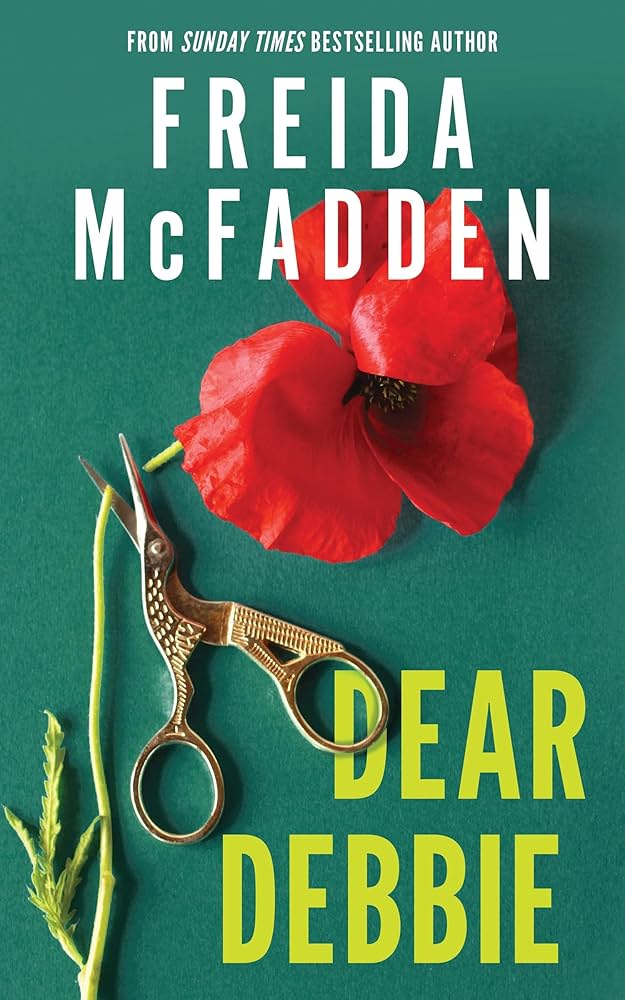
Dear Debbie
| Published | 2026-01-27 |
| Series | Standalone |
| Genre | Psychological Thriller, Domestic Suspense |
| Language | English |
| Publisher | Poisoned Pen Press / Hollywood Upstairs Press |
| ISBN-10 | 1464249628 |
| ISBN-13 | 978-1464249624 |
📝Honest Review
Debbie herself is the key to everything. She is unlike most of McFadden's protagonists, who tend to be women in reactive positions, being gaslit, being threatened, discovering terrible truths about the men they married. Debbie is not reactive. She is a former MIT computer science prodigy who chose domestic life and now, thirty years later, is watching that choice disintegrate from the inside. She is brilliant and slightly unhinged and she has an extremely clear sense of who deserves what in the world around her. When she decides to stop dispensing advice and start dispensing consequences, the results are not the impulsive thrashing of a woman in crisis. They are the calculated, technically sophisticated, often hilarious operations of someone who has been paying attention for decades and has finally decided to use what she knows.
The dark comedy in Dear Debbie is sharper and more confident than in McFadden's previous work. The book knows it is funny. Debbie knows she is funny. There is a self-awareness running through her narration that keeps the reader's sympathy firmly in place even as the things she does escalate well beyond anything a reasonable person would endorse. McFadden manages a genuinely difficult trick here, making you cheer for someone who is technically doing terrible things, by making both the justice of her grievances and the satisfaction of her methods feel earned rather than gratuitous. You want her to get away with it. You want the book club women and the predatory educators and the husband with his secrets to get exactly what is coming to them. And the book, generously, delivers.
The pacing is McFadden at her most disciplined. The chapters are short and end at exactly the right moment to make you begin the next one. The reveals are timed well, spaced throughout the narrative rather than dumped at the end, which gives the book an ongoing sense of momentum rather than a single climactic jolt. The multiple points of view, including sections from Debbie's daughters and from other characters whose lives intersect with hers, add texture and the occasional interesting complication to what could have been a more one-dimensional story.
Where the book is less convincing is in its third act, which accumulates coincidences at a rate that eventually strains even the willing suspension of disbelief the book has carefully cultivated. The revelation that ties together Debbie's past trauma and her present situation requires several things to be simultaneously true that, taken individually, are each plausible, but stacked together begin to feel engineered rather than discovered. McFadden has always been a writer who prizes the plot mechanism over psychological realism in her endings, and readers who have followed her work will recognize this as a recurring pattern. It does not ruin the book. It does, however, interrupt the particular pleasure of the first two thirds.
There is also something genuinely interesting in the book's central premise that McFadden uses more than she fully explores. Debbie running an advice column and then deciding to stop advising and start acting is a rich irony that points toward questions about the gap between telling other people what to do and doing it yourself, about the wisdom we dispense freely to others that we cannot apply to our own lives, about what it costs a woman to play the reasonable, measured, helpful role for decades. The book touches on all of this without quite committing to it as its central concern. It is a thriller first and a meditation second, which is a perfectly legitimate choice, though the meditation is interesting enough that you occasionally wish the book had slowed down long enough to inhabit it more fully.
None of which changes the fact that Dear Debbie is enormously enjoyable, sharply written, and the kind of book that makes a Sunday afternoon disappear. As revenge thrillers go, it is very close to the top of its class.
Summary:
Debbie Mullen has spent years writing an advice column called Dear Debbie for her local New England newspaper, patiently counseling women who write in about difficult husbands, crumbling marriages, and lives that have slowly stopped belonging to them. She is practical, measured, always the voice of reason. Then Debbie loses her job, discovers her husband is hiding things on his phone, notices her teenage daughters pulling away from her in ways she cannot quite explain, and runs into someone from her past who brings back memories she has spent decades trying to bury. Something shifts. Debbie is done being reasonable. She is done being the bigger person. She has been telling other women for years what they should do when the people around them fail them. It is time, she decides, to start taking her own advice. What follows is a darkly funny, increasingly unhinged, and deeply satisfying revenge story about a woman with a sharp mind, an excellent memory, a background in computer science, and absolutely nothing left to lose.
✅ What I Liked
Debbie as a protagonist is genuinely original within McFadden's catalog, proactive and calculating rather than reactive and threatened, which gives the book a refreshing energy. The dark comedy is sharper and more confident than in her previous work. The pacing is relentless in the best possible way. And the suburban New England setting, with its book clubs and school politics and carefully maintained surfaces, is skewered with real wit.
❌ What Could Be Better
The third act piles coincidence upon coincidence in a way that temporarily breaks the spell the first two thirds carefully construct. The deeper thematic material about advice-giving women and self-application of wisdom is more interesting than the book fully commits to exploring. And readers who have found McFadden's endings overly contrived in previous books will find the same pattern here, well-executed but recognizable.
Discover Your Next Great Read
Handpicked recommendations from our collection of literary treasures


💬Discussions