
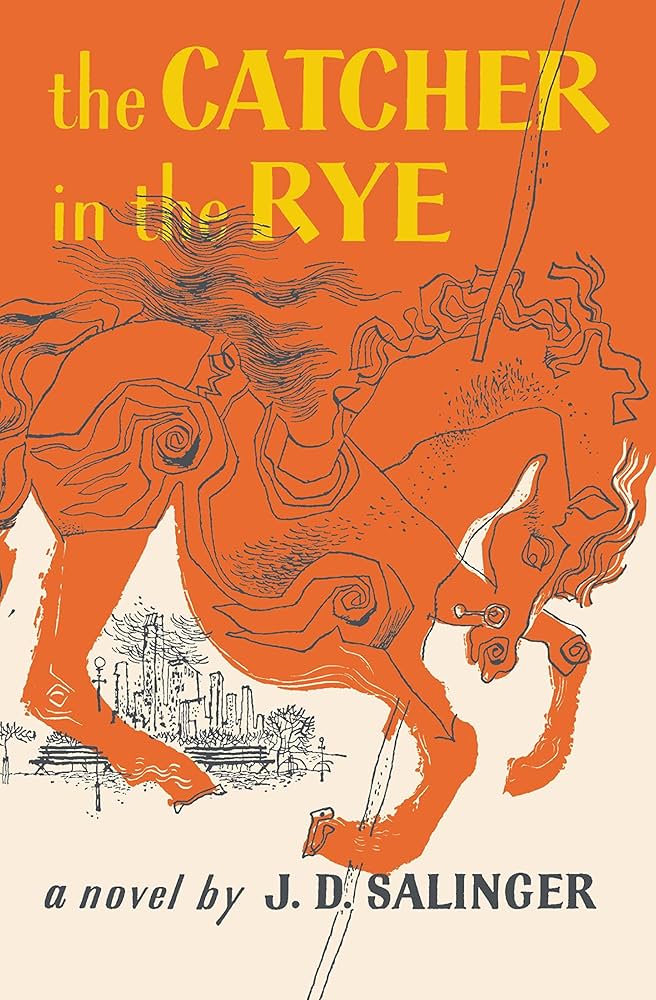
The Catcher in the Rye
| Published | 1951-07-16 |
| Series | standalone |
| Genre | Literary Fiction, Coming-of-Age |
| Language | English |
| Publisher | Little, Brown and Company |
| ISBN-10 | 0316769487 |
| ISBN-13 | 978-0316769488 |
📝Honest Review
the setup is simple. Holden Caulfield is sixteen, just been kicked out of yet another prep school, and instead of going home to face his parents he disappears into New York City for three days. that is more or less all that happens in terms of plot. he wanders around, talks to people, drinks in bars, visits his little sister Phoebe, thinks about his dead brother Allie constantly, and calls almost everything he encounters phony. the plot is not the point. the point is the voice.
and the voice is extraordinary. i do not think there is another narrator in twentieth century American fiction quite like Holden. he talks the way a smart unhappy teenager actually thinks, which is to say in circles, going back and revising himself, noticing things he cannot quite explain, furious at things he cannot quite name. Salinger wrote him in 1951 and he still sounds contemporary in a way that should probably not be possible after seventy years. the fact that it works is not an accident. it is the result of very precise writing that looks casual but is not.
what the book is actually about, underneath the teenager-hating-phonies surface, is grief. Holden's younger brother Allie died of leukemia a few years before the novel begins and Holden has never come anywhere close to processing it. the phoniness he sees everywhere is partly real, teenagers are right that adults do perform a lot of their lives, but it is also a way of staying angry so that he does not have to feel the sadder thing underneath. every time the book gets close to Allie it shifts. Holden changes. the sarcasm drops. you get a glimpse of what he is actually carrying and then the wall goes back up.
the scene with his sister Phoebe is where the book earns everything it has been building toward. she is the one person Holden cannot perform around. she calls him on his nonsense, she loves him without conditions, and when he tries to explain to her what the catcher in the rye fantasy actually means, what he wants to do in the world, it is the most honest he is at any point in the novel. it is also a little heartbreaking because the fantasy he describes is not really about saving children from falling off a cliff in a rye field. it is about saving himself from having to grow up and lose more things he loves.
the thing people miss about Holden, especially people who find him insufferable, is that he is not actually angry at other people for being fake. he is angry at himself for being unable to stop noticing it and unable to do anything about it. he sees through things he wishes he could just accept. that is an exhausting way to be sixteen. it is an exhausting way to be any age. and Salinger captures that exhaustion so well that the book can feel almost physically tiring to read in the best possible way, like you have spent three days wandering a city with someone who will not stop talking but who also, occasionally, says something that cuts right through you.
the Mr. Antolini scene is one i think about more than almost any other scene in the book. Holden goes to see his old English teacher in the middle of the night, one of the few adults he actually respects, and something happens that sends him fleeing into the cold. what actually happened and what Holden thinks happened are deliberately left unclear and Salinger does not resolve it for you. it is one of those moments where the book trusts you to sit with the ambiguity and i think a lot of readers, especially younger ones, rush past it without quite registering what Salinger put there.
the ending frustrated me the first time i read it. it still does slightly. Salinger does not give you a resolution and Holden does not arrive anywhere in particular. you find out he is telling the story from somewhere, some kind of treatment facility presumably, and that he might go back to school in the autumn, and that is about all. but i have come to think that the lack of resolution is the point. people like Holden do not have tidy endings. they have bad days and better days and they carry their grief for years and they learn, slowly and imperfectly, to live alongside it. an ending that wrapped things up would have betrayed everything the book was doing.
i would give it four and a half out of five. the half point off is for a stretch in the middle where the wandering feels a little too structureless even for a book that is deliberately structureless, and i found myself wanting it to find its footing again. it always does. but the sag is there and it is real.
read it. and if you read it years ago and thought Holden was just an annoying rich kid with nothing real to complain about, try it again. the annoying rich kid is still there. but so is everything else.
Summary:
Sixteen year old Holden Caulfield gets expelled from his Pennsylvania prep school and spends three restless days wandering New York City, unable to go home, railing against everything he finds fake or hollow in the adult world. It is a book about loneliness and grief dressed up as a book about a difficult teenager.
✅ What I Liked
Holden's voice is completely unlike anything else in American fiction. The book is funny in a way that sneaks up on you and then quietly devastating in a way that does the same thing.
❌ What Could Be Better
If you read it expecting a plot in the traditional sense you will be frustrated. Things happen but not in a way that builds toward a conventional resolution and some readers find that genuinely unsatisfying rather than intentional.
Discover Your Next Great Read
Handpicked recommendations from our collection of literary treasures





💬Discussions