
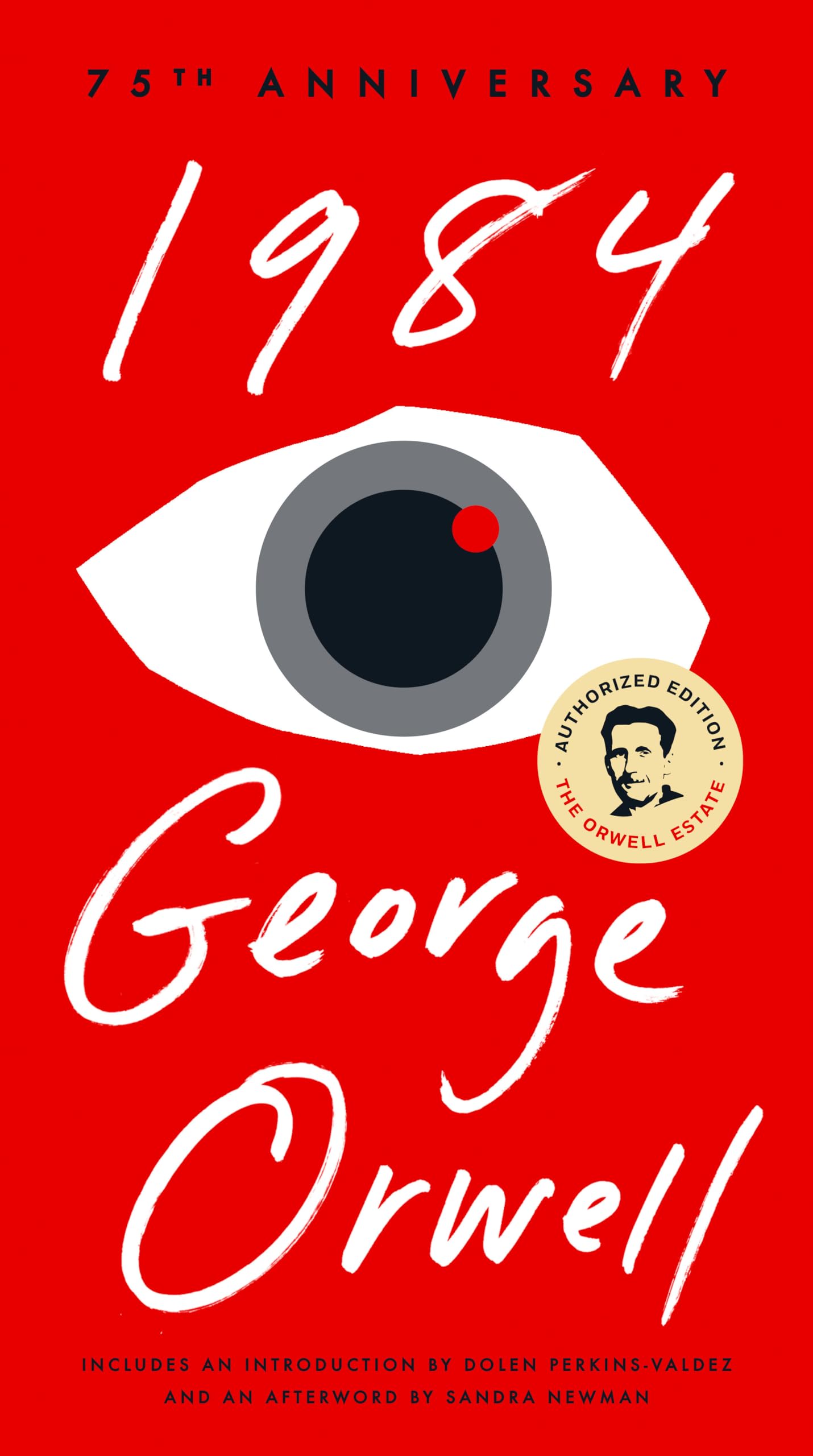
Nineteen Eighty-Four
| Published | 1949-06-08 |
| Series | standalone |
| Genre | Dystopian Fiction, Political Fiction |
| Language | English |
| Publisher | Secker & Warburg (original) |
| ISBN-10 | 0140126716 |
| ISBN-13 | 978-0140126716 |
📝Honest Review
the story follows Winston Smith, a thirty-nine year old man living in London, now called Airstrip One, in a totalitarian superstate called Oceania ruled by the Party and overseen by the omnipresent face of Big Brother. Winston works at the Ministry of Truth, which is the ministry responsible for rewriting history so that the Party's version of the past is always the correct one. he spends his days altering newspaper archives and his evenings trying to hold onto the faint memory that things were once different. the crime in this world is not what you do but what you think. the Thought Police are always watching. the telescreens in every room watch back.
what Orwell understood, and what makes this book feel so different from other political dystopias, is that the most terrifying thing a government can do is not restrict your body but destabilise your relationship with reality. the Party does not just control what you can say or do. it controls what you can know, what you can remember, and eventually what you can believe. the concept of doublethink, holding two contradictory beliefs simultaneously, is the mechanism by which this works. you can know that something is false and believe it is true at the same time because the alternative is too dangerous. Orwell describes this process so precisely that reading it feels less like reading fiction and more like reading a manual for something that actually happens.
Winston's private rebellion begins with a diary. he starts writing in it knowing that if anyone finds it he will be vaporised, which is the word for what happens to people who disappear. the act of writing private thoughts down, of asserting that what he remembers is what actually happened, is the first crack in the wall. then he meets Julia, a younger woman who works in the Fiction Department, and they begin an affair, and for a while the book becomes something almost warm. they find a room above an old shop where there are no telescreens. they have a few months of something approaching ordinary life. Orwell lets you breathe during this section, which in retrospect is extremely cruel of him.
O'Brien is the character i think about most after finishing the book. he is a senior Party member who Winston has always secretly believed is also a rebel, a fellow dissenter pretending to conform. the relationship between them is one of the most carefully constructed things in the novel and i do not want to say too much about how it resolves for anyone who has not read it. what i will say is that O'Brien is one of the great villains in fiction not because he is cruel in the way villains usually are but because he is intelligent and honest in a way that makes his cruelty worse. the conversation in Room 101 between Winston and O'Brien is probably the best writing in the book. it is also the most frightening.
the ending is inevitable from fairly early on and Orwell does not try to hide it. you know where this is going. the question is just how completely it goes there, and the answer is completely. the Party does not just break Winston. it makes him love them. the final line of the novel is one of the most well-known in twentieth century literature and it lands as hard as it does because Orwell has earned it. there is no twist. there is no rescue. there is just a man at a café table and a face on a screen and a feeling of something closing that was never really open.
what i think people sometimes miss about this book is that it is not just a political warning, though it is that. it is also a book about the importance of holding onto what you know is true even when everything around you is telling you that you are wrong. Winston's tragedy is not that he was defeated, he was always going to be defeated, it is that he was made to participate in his own defeat, to choose it, to feel grateful for it. that is the thing Orwell was most afraid of. not that power would crush dissent but that power would eventually make dissent feel like the thing you most wanted to be free of.
i would give it five out of five and i would say read it at least once in your life. just know what you are getting into. this one stays with you and not in the comfortable way.
Summary:
Winston Smith lives in a totalitarian superstate where the government controls not just what you do but what you think and remember. His job is rewriting history. His crime is that he quietly refuses to forget it. A love affair and a small private act of rebellion follow. The Party knows about both. This is Orwell's last novel, written while he was dying of tuberculosis on a remote Scottish island, and it reads like someone who had run out of time to be anything other than completely honest about what he was afraid of.
✅ What I Liked
what stays with me most is how precisely Orwell understood the mechanics of how power actually works. Big Brother is not just a dictator and the Party is not just a repressive government. what Orwell describes is something more specific and more frightening, the systematic destruction of a person's ability to trust their own mind. the concept of doublethink, holding two contradictory beliefs simultaneously and genuinely believing both, is one of the most accurate descriptions of how authoritarian control operates that anyone has ever written. the fact that he wrote it in 1949 without a template for it is remarkable.
❌ What Could Be Better
the long passages from the book within the book, the underground manifesto Winston reads in the middle section, are genuinely hard going. Orwell is using them to explain the theoretical logic of the Party's control and some of it is brilliant. but it is also dense and essayistic in a way that stops the story dead for too long, and i think it is where a lot of readers quietly give up. it is a structural problem he probably knew about and did not have enough time or health left to solve.
Discover Your Next Great Read
Handpicked recommendations from our collection of literary treasures


💬Discussions