
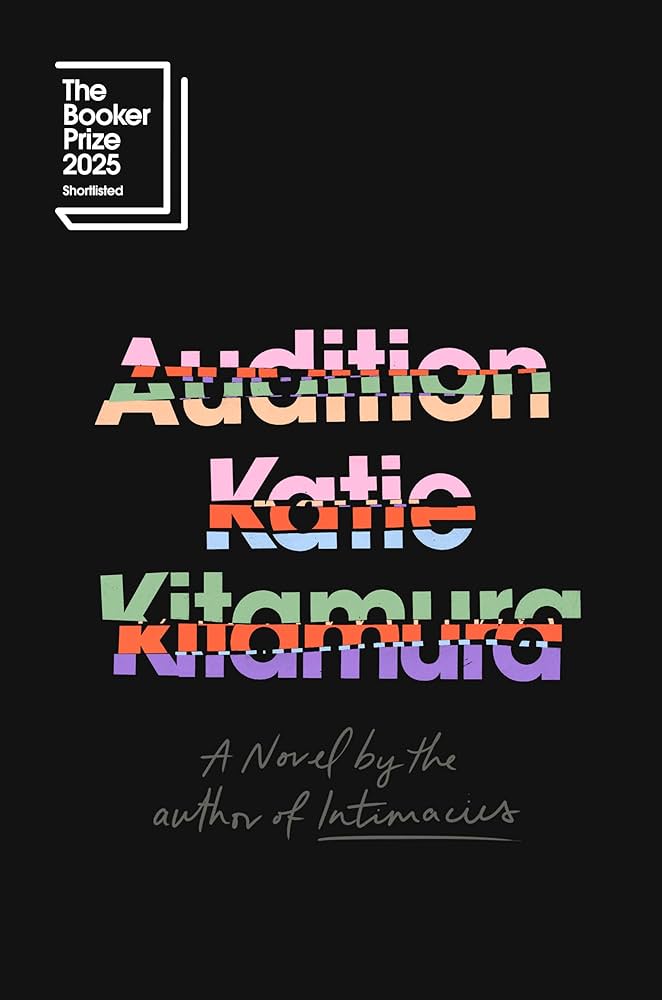
Audition
| Published | 2025-04-08 |
| Series | Standalone |
| Genre | Literary Fiction, Psychological Fiction |
| Language | English |
| Publisher | Riverhead Books (US) / Fern Press (UK) |
| ISBN-10 | 059385232X |
| ISBN-13 | 978-0593852323 |
📝Honest Review
The novel is short, barely over two hundred pages, and written in Kitamura's characteristic prose, spare and formal and so precisely controlled that every word feels like it has been placed rather than written. There is almost no register of the casual or the spontaneous in her sentences. Every utterance or gesture, as one reviewer accurately observed, carries subtext, and the effect of reading her is less like entering a story and more like watching a very skilled and very composed person perform the act of telling one. That distance is not an accident. It is the entire point.
The central premise, an actress and a young man whose exact relationship remains deliberately unspecified, is Kitamura at her most formally playful. She is interested in what happens when the same scene is replayed under different conditions, what changes and what stays the same, what the difference reveals about character versus circumstance. The two-halves structure, in which the first half presents the narrator as a woman without children and the second presents her as a mother, is a theatrical device in a very literal sense. It is the kind of experiment that a playwright might design, and Kitamura, who is writing about a theatre director and actress and working from a play called The Opposite Shore, is clearly aware of the formal parallel she is drawing.
The young man at the center of the novel is genuinely interesting in his opacity. He is not a villain, not a lover in any conventional sense, not clearly anything that would allow the reader to organize their understanding of him into a familiar category. He is a presence that means different things in the novel's two halves, and the meaning produced by that shift is the novel's central argument, though Kitamura, characteristically, never makes the argument explicit. She presents the data and trusts the reader to draw conclusions, or not, depending on what they bring to it.
What Kitamura does better than almost any other novelist working in this register is the rendering of social discomfort, the texture of a conversation in which what is being said and what is meant are operating at a significant distance from each other, in which both participants are performing something they have not consciously chosen and cannot quite control. Her scenes at the restaurant, in the theatre rehearsal room, in the apartment where her narrator lives with a husband who seems increasingly like a character in a different kind of novel, have the particular energy of situations in which nothing is settled and nothing can be made to settle.
Where the novel is less satisfying is in the question of what all this formal machinery is ultimately in service of. Kitamura's previous novel Intimacies generated the same division, but there the emotional stakes felt more grounded, the novel's inquiry into identity and complicity more viscerally felt. Audition is, as one Goodreads reviewer put it, perhaps trying a little too hard to be clever, and the structural experiment, while genuinely interesting as an intellectual exercise, can feel at certain points like a display of technique that the novel's emotional content is not quite sufficient to fully justify. The cold is real, but whether it is cold in the way of a precise surgical instrument or cold in the way of a room where the heating has been left off is a question the novel leaves more open than it perhaps intends.
This is not a disqualifying criticism. Audition is still one of the most formally interesting novels published in 2025, still full of sentences that make you stop and read them twice, still a book that rewards active, demanding engagement in a way that most literary fiction does not. But it is Kitamura's most abstract and most hermetically sealed work, and readers who found their way to her through the more emotionally generous Intimacies may find this one harder to love, though easier to admire.
Summary:
Two people meet for lunch in a Manhattan restaurant. She is an accomplished actress, middle-aged, in the middle of rehearsals for an upcoming premiere of a play called The Opposite Shore. The young man across the table is attractive and troubling and young enough to be her son. The question of who exactly he is to her, and what she is to him, is one that Audition holds open with deliberate care. The novel is structured in two halves, like a play, and the two halves present two versions of the same woman navigating the same relationship from fundamentally different positions. In one she has no children. In the other she does. The difference reshapes everything, and the novel uses that reshaping to ask a set of questions it never quite answers directly: about the roles we perform in our intimate lives, about whether performance and authenticity can be meaningfully separated, about what we hide from the people who think they know us, and whether identity is something we have or something we do.
✅ What I Liked
The prose is immaculate, controlled, and precise in ways that make even the most uncomfortable social exchanges feel almost pleasurably sharp. The two-halves structure is a formally inventive device that genuinely does what it sets out to do, presenting the same relationship under different conditions and using the gap to ask real questions about identity and performance. Kitamura's rendering of social unease and the texture of conversations in which subtext and surface are operating at maximum distance from each other is unlike anything else being written in contemporary literary fiction.
❌ What Could Be Better
The novel's formal ambition occasionally outpaces its emotional content, producing a reading experience that is more admirable than affecting. The deliberately withheld information about the young man and his exact relationship to the narrator can feel like opacity as a stylistic choice rather than opacity as the experience of a character who genuinely does not know, which are not the same thing. And readers coming to this from Intimacies may find that the slightly warmer novel they encountered there has not quite followed them here.
Discover Your Next Great Read
Handpicked recommendations from our collection of literary treasures








💬Discussions