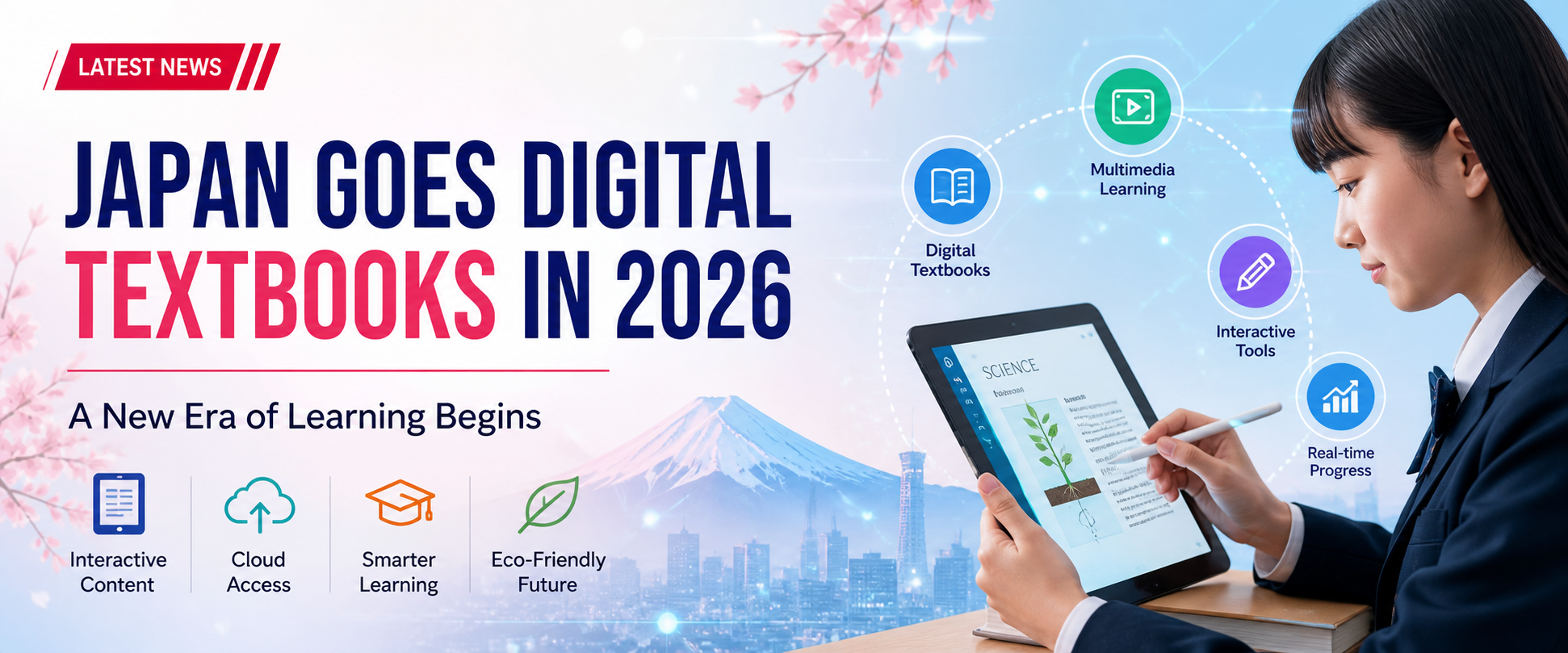
🗾 on April 7 2026 Japan's cabinet approved a bill putting digital textbooks on tablets on equal legal footing with paper ones for the first time under the School Education Law
🗾
Japan's School Education Law Amendment
Cabinet approval April 7 2026 — enforcement target April 2027 — classroom rollout from fiscal 2030
Education Reform
Digital Policy
Tablet Learning
GIGA School
for the first time in Japan's educational history digital textbooks carry the same legal weight as paper ones. local education boards pick their own format. no single approach is being forced on every school.
Japan has been talking about putting tablets in classrooms for a long time. the GIGA School initiative got devices into students' hands during the pandemic years and by 2023 most children in compulsory education had a tablet somewhere in their school life. but the law never caught up with the hardware. under the old School Education Law, paper textbooks were the official thing. digital versions existed and schools could use them but they counted as supplementary materials at best. you could not treat them as the primary teaching tool without being in a legal grey area. a lot of schools held back because of that, which meant the tablets sat there doing less than they could have.
on April 7 2026 the cabinet approved a bill that changes this. the Partial Amendment to the School Education Act formally puts digital textbooks on the same legal level as paper ones. they go through the same government screening process, the same official adoption process, and they get distributed free to students the same way paper textbooks always have been. this is not a pilot. it is a change to the actual law that defines what a textbook is in Japan and that matters.
i want to be clear about one thing though because i think a lot of coverage blurred it. this is not a mandate. the Minister of Education said explicitly there will be no uniform adoption. local education boards pick from three options when the rollout begins in fiscal 2030. paper only, digital only, or a mix of both. the government is not telling every school to throw out their books. it is saying that if a school wants to go fully digital the law now fully supports that. that is a real change. it is just a more careful one than some headlines made it sound.
📅
Decision date
April 7 2026 cabinet approval
⚖️
Law changed
School Education Act formally amended
🏫
Rollout
In classrooms from fiscal 2030
🔍
Screening
Government review of digital titles from 2028
🗳️
Who decides
Each local education board chooses
💴
Cost to families
Free distribution same as paper textbooks
the goal is to use the strengths of both paper and digital. there will be no uniform adoption.
Minister of Education Matsumoto on the April 7 cabinet decision
9yrs
of compulsory education where Japan provides textbooks free under law
2028
when government screening of digital textbook titles begins
2030
the fiscal year digital textbooks can first be used officially in classrooms
3
format options for every school — paper only, digital only, or both
📋 What Actually Changed and Why It Matters
the most important thing the amendment does is close the legal gap between what schools already had in their hands and what they were officially allowed to treat as a textbook. that gap was a real problem. it meant digital learning was always the unofficial option, always slightly less legitimate in the eyes of the system even when the actual outcomes were fine. that changes now.
1
digital textbooks now carry the same legal weight as paper ones
before this amendment a digital learning material was a supplementary aid. useful but not official. a school that wanted to teach primarily from a tablet was technically outside the standard framework even if the content was identical to the paper version. the amendment closes that. a digital textbook that passes government screening now counts the same in law as anything that has ever been printed and put on a school desk. schools can actually commit to it now instead of hedging.
2
the same national screening process applies to digital content
one of the things that makes Japanese textbooks trusted is that they go through a national screening process before any school can officially use them. the amendment applies that same process to digital titles. this is not a small thing. it means digital textbooks are being treated as serious educational content subject to real quality standards and not just apps that showed up on a marketplace. the screening starts in fiscal 2028 which gives the system two years to build out the review process properly before anything goes into a classroom officially.
3
free distribution covers digital formats the same way it covers paper
Japan has provided textbooks free to every child through nine years of compulsory schooling for a long time. that principle now extends to digital textbooks. if your school switches to tablets your family does not pay more. the cost gets absorbed the same way it always has been for paper. i think this matters more than most people are giving it credit for because it means the decision to go digital is a teaching choice not a financial one. families in lower income areas are not left out if their local board chooses the digital path.
4
younger children will be treated more carefully
the education ministry has said it will likely limit digital-only adoption for children in the lower years of elementary school. the thinking is that younger children may benefit more from paper-based learning for cognitive development reasons. honestly this is the most sensible part of the whole decision. the research on young children and screens is genuinely mixed and at least the government is acknowledging that rather than just pushing tablets at every age group at once.
5
a privacy law amendment went through on the exact same day
this one barely got mentioned in most of the coverage i saw and it should have. digital textbooks collect learning data in ways paper never could. the government approving a privacy law amendment on the same day as the textbook bill was not a coincidence. they are trying to build the legal framework for how that data gets used before it starts flowing at scale from 2030. whether the protections are strong enough is a question for people who know privacy law better than i do. the fact that they tried to address it at the same time is at least the right instinct.
the hardware arrived years before the law caught up. now the law has caught up. what happens next depends on whether schools and teachers and parents trust the change enough to actually use it.
⚠️ The Concerns Being Raised — and My Honest Take on Them
you cannot write about this honestly without spending real time on the pushback because it is not coming from people who are just scared of new things. some of it is coming from neuroscientists and education researchers who have looked at what happened in other countries and are genuinely worried.
1
Sweden reversed course and it cost them a lot of money and time
Sweden invested around 104 million euros pushing digital learning into schools across the country and then spent a significant amount reversing that decision after reading scores dropped and research showed shallower comprehension on screens compared to paper. Norway showed similar patterns. Professor Kuniyoshi Sakai at the University of Tokyo, who studies the neuroscience of language, said publicly that it is premature to give digital textbooks official status before anyone has checked whether they actually perform as well as paper ones. i think that is a fair point and the data from Scandinavia is not something you just wave away.
2
Japan already has a serious problem with children and myopia
Japan has one of the highest rates of myopia among children of any country. adding compulsory hours of close screen use in classrooms on top of what children already do at home is a real health concern and not a small one. some researchers have specifically argued for e-ink displays rather than backlit tablets because of blue light exposure. the government has not addressed this in any real detail yet and that feels like a gap. you cannot make digital textbooks officially free to distribute without also saying something about what kind of screens schools should actually be using.
3
the memory retention research does not clearly favour screens
Japan's own government-funded research from 2021 showed lower memory retention with digital materials compared to paper in some contexts. the government cites studies showing that children already used to digital learning show smaller differences. both things can be true at the same time and the honest answer is that the research is not settled. my issue with the government's position is not that they are necessarily wrong. it is that they are moving fast on something that affects millions of children and the evidence they are leaning on is not as solid as they are making it sound.
4
the digital divide in Japan is real and this reform could make it worse
the GIGA School initiative distributed devices broadly but device quality, school internet reliability, and teacher confidence with digital tools varies a lot between cities and rural areas. giving local education boards a free choice sounds like a good thing until you think about what it means for a board in an under-resourced area that technically has the option to go digital but does not have the infrastructure to make it work. if the rollout support is not careful this could widen gaps that already exist rather than close them.
what the government says about all of this
the Ministry of Education points to studies showing children accustomed to digital learning show no noticeable difference in comprehension or academic performance compared to peers on paper. the gradual timeline, screening from 2028 and classroom use from 2030, is meant to give time to watch outcomes before anyone commits fully. critics say that is still not long enough to understand what happens to children over years of digital-primary education. the real answer will be in the data coming out of the early adopting schools from 2030 onward and i think most people on both sides of this debate know that.
🌍 Why This Matters if You Are Not in Japan
i follow this because it connects directly to something i think about a lot which is what reading on a screen does compared to reading on paper. that question is not just an education policy question. it sits underneath every conversation about ebooks and audiobooks and digital reading generally. Japan doing this formally and at scale means we are going to get real data on it at a size no previous study has been able to match.
Japan produces some of the most closely watched education data in the world. their PISA scores get analysed by every education ministry in every country that takes schooling seriously. when results come in from the 2030 rollout, from schools using digital textbooks as their primary teaching material for the first time, those numbers will be studied by people in South Korea, India, Germany, the UK and everywhere else having the same conversation about screens in classrooms. Japan is not running a small experiment here.
the legal question matters too. Japan formally recognizing digital textbooks as textbooks under national law is a statement about what counts as official knowledge delivery in a school. other countries with their own legal definitions of what a textbook is will now have to decide whether that framing works for them. that conversation is going to happen in policy circles everywhere and Japan's experience will be the main thing people keep coming back to when they argue either way.
and if you are someone who cares about books and reading the way i do, sit with this for a second. Japan's government just said formally and legally that reading on a screen is equivalent to reading on paper for the purposes of official education. that is the most significant government statement on that question that any major country has ever made. you can agree with it or not but it happened and the data that comes out of it is going to shape how people think about reading formats for a long time.
a note on the timeline for anyone following this closely
the cabinet approved the bill on April 7 2026. enforcement of the amended law is targeted for April 2027. government screening of digital textbook titles begins in fiscal 2028. the first schools can officially use digital textbooks as their primary materials from fiscal 2030. there is a long gap between the legal change and the classroom reality and a lot can change in that window. the 2028 screening process will be the next real moment to watch if you want to understand where this is actually heading.
📚 Explore Education and Reading in Our Library
we cover books technology education and what reading means right now. thousands of titles across every genre, no sign up needed and no cost.
Browse the Free Library →