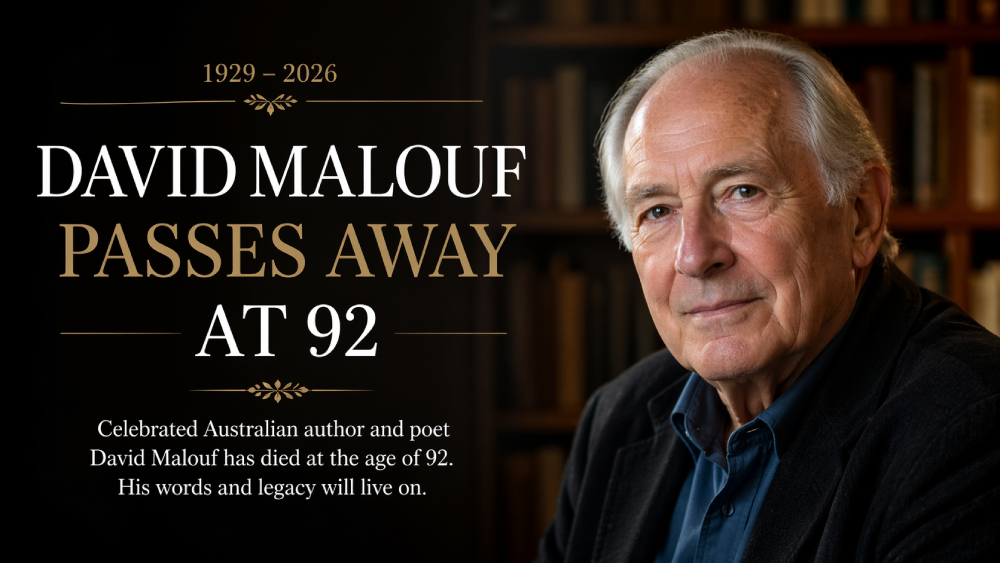
David George Joseph Malouf AO
·
20 March 1934
—
22 April 2026
·
Aged 92
David Malouf AO — Australian author, poet and literary giant. 1934–2026.
Australia has lost its greatest living writer. David Malouf AO, one of the most celebrated and internationally acclaimed authors the country has ever produced, passed away on 22 April 2026 at the age of 92. His publisher, Penguin Random House Australia, confirmed the news, describing the loss as felt across the entire Australian literary world and far beyond.
For more than five decades, Malouf gave language to the Australian experience in ways no other writer had managed — capturing the country's vast, difficult beauty, its colonial wounds, its deeply human stories, and the inner lives of the men and women who inhabited it. He worked across fiction, non-fiction, poetry, opera libretti, and plays, and in every form he brought the same quality that his readers and critics came to recognise as distinctly, irreplaceably his: a prose of rare poise, grace, and moral seriousness.
📋 David Malouf — At a Glance
Born
20 March 1934, Brisbane, Australia
Died
22 April 2026, aged 92
Heritage
Lebanese Christian father; Sephardic Jewish mother
Genres
Fiction, Poetry, Non-Fiction, Opera Libretti
Publisher
Penguin Random House Australia; UQP
Notable Honour
Order of Australia (AO)
Career Span
1970 – 2026 (56 years)
🌏 A Life Rooted in Two Worlds
Malouf was born in Brisbane on March 20, 1934, to a father from a Catholic Lebanese background and a mother from a family of Sephardic Jews from Spain. This rich multicultural heritage — rarely acknowledged in the Australia of his childhood — would quietly permeate everything he ever wrote: his lifelong preoccupation with identity, with belonging, with the question of what it means to be at home in a place that does not quite recognise you.
Having graduated from the University of Queensland, the 24-year-old Malouf embarked in 1959 for England, where he taught for the next decade in secondary schools. During this period, he travelled extensively in Europe, worked on his poetry, and began early drafts of his first novel. Returning to Australia in 1968, he took up a teaching post in English at the University of Sydney. That decade in Europe — living between two continents, writing at the edges of two cultures — gave his voice a quality of restless, cosmopolitan curiosity that never left him.
In 1978, Malouf relinquished his university post and went to live for ten months each year in Campagnatico, an isolated village in Italy. There he dedicated himself to writing without distraction, but maintained connections with Australia and his peers. He returned to Australia in the early 1980s, settling in inner Sydney. It was in that Italian silence, far from the noise of academic life, that some of his finest work was written.
"What you hope as a writer is your setting it all down will make people look at their own lives and ask questions about what kind of country we want to be — questions about how we came to be the country we are."
— David Malouf
📚 The Major Works — A Literary Legacy in Full
Malouf's novels are cherished by readers — from Johnno (1975), An Imaginary Life (1978), Child's Play (1981) and Fly Away Peter (1982) to Harland's Half Acre (1984), The Great World (1990), Remembering Babylon (1993), Conversations at Curlow Creek (1996) and Ransom (2009). Across nine novels, eight poetry collections, four opera libretti, and four short story collections, he built one of the most coherent and distinguished bodies of work in Australian literary history.
1975Novel
Johnno
Malouf's debut novel and a landmark of Australian fiction. A deeply autobiographical portrait of growing up in wartime Brisbane — a sensory hymn to a ramshackle town becoming a city, and a study in friendship, identity, and the way a place shapes who you are.
🏆 Miles Franklin Award Winner
1978Novel
An Imaginary Life
Malouf's internationally acclaimed second novel recreates the experience of the ageing Roman poet Ovid, exiled to the remote edge of the empire. Through his encounter with a wild child, Ovid opens himself newly to the world and to his own mortality. A novel about language, civilisation, and what it means to be truly human.
⭐ International Breakthrough Work
1982Novel
Fly Away Peter
A poignant, beautifully structured novel about friendship, innocence, and the destruction of the First World War. Two birdwatchers in Queensland — one young, one old — are pulled into the catastrophe of the Somme. Malouf writes war and peace with equal, devastating grace.
📖 Widely Studied Classic
1990Novel
The Great World
Spanning two generations of Australians through both World Wars and beyond, The Great World is Malouf's most expansive novel — a meditation on friendship, survival, memory, and the ordinary heroism of lives lived quietly in the shadow of history.
🏆 Commonwealth Writers' Prize · Prix Femina Étranger
1993Novel
Remembering Babylon
Widely regarded as his masterpiece. Set in colonial Queensland, a young British boy cast ashore and raised by Aboriginal Australians returns to the European settler community — and becomes a force that both fascinates and terrifies. A blazing exploration of colonisation, identity, language, and belonging. Shortlisted for the Booker Prize.
🏆 IMPAC Dublin Literary Award · Booker Prize Shortlist
2009Novel
Ransom
Malouf's final novel, and one of his finest. A reimagining of the last book of Homer's Iliad — the aged King Priam crossing enemy lines to beg Achilles for the body of his slain son Hector. A profound meditation on grief, mercy, humility, and what it means to be a man beyond the roles history assigns you.
🏆 Miles Franklin Award Winner
1970–2009Poetry
Eight Poetry Collections
Beginning with Bicycle (1970) and Neighbours in a Thicket (1974), Malouf published eight collections across his career. His poetry, like his fiction, is marked by intense attention to landscape, language, and the Australian experience — and remained in print and widely read throughout his life.
📜 UQP · Ongoing Legacy
1986Libretto
Voss (Opera Libretto)
Based on Patrick White's iconic Australian novel, Malouf wrote the libretto for Richard Meale's opera Voss, which opened at the Adelaide Festival in 1986 to great acclaim. He also wrote libretti for three further operas, establishing himself as one of Australia's most distinguished contributors to the operatic form.
🎭 Adelaide Festival 1986
🏆 Awards & Honours — A Career in Recognition
Over a career spanning more than five decades, Malouf accumulated honours from every corner of the literary world. His prizes were not the kind that decorate writers for a single clever book — they were sustained recognitions of an entire, extraordinary body of work.
1975
Miles Franklin Award
For Johnno — Australia's most prestigious literary prize, recognising the best novel of Australian life.
1990
Commonwealth Writers' Prize & Prix Femina Étranger
For The Great World — international recognition cementing Malouf's global reputation.
1993
Booker Prize Shortlist & IMPAC Dublin Literary Award
For Remembering Babylon — widely considered his masterpiece and the novel that brought him his largest international readership.
2000
Neustadt International Prize for Literature
One of the world's most prestigious literary prizes — often described as the American Nobel — awarded for lifetime achievement.
2008
Fellow of the Royal Society of Literature
Election to one of the world's oldest and most distinguished literary bodies.
2008
Australia-Asia Literary Award
For The Complete Stories — the inaugural winner of this prize recognising literary bridges between Australia and Asia.
2009
Miles Franklin Award
For Ransom — his final novel, winning Australia's highest literary honour for the second time.
2016
Australia Council Lifetime Achievement Award
The Australian arts community's highest honour, recognising an extraordinary contribution to the nation's cultural life.
💬 The World Pays Tribute
News of Malouf's passing drew an immediate outpouring of grief and admiration from across the literary and political world. His reach was not the narrow reach of a writer known only to academics or prize committees — he was genuinely, widely loved.
In both poetry and prose, David dealt in hard truths and deep insights. He captured the harsh, vast and intense beauty of our land and the lives it shaped.
— Prime Minister Anthony Albanese
Everyone at PRH loved working with David, talking and laughing with him, hearing family stories, discussing the books he had read and the film, music, art and work he admired. He was committed to reading and supporting new Australian writers. He has left behind a body of work that comforts, challenges and entertains.
— Meredith Curnow, Penguin Random House Australia
David Malouf was a giant in the world of literature. His contribution to Australian culture is immeasurable. It was my great honour to represent David and this is a great loss.
— David's Literary Agent
Alongside his achievements as a writer, David was a loyal, loving friend to many and devoted to his family. He was a passionate supporter of Opera Australia, Adelaide Writers Week, and the Indigenous Literacy Foundation. Those who knew him spoke not only of the brilliant writer but of the generous, warm, and deeply curious human being behind the work — someone who loved music, film, art, and conversation as much as he loved literature.
🕯️ What He Leaves Behind
In the wake of writers such as Kenneth Slessor and Patrick White, Malouf forged new pathways for settler Australian literature. Where Patrick White had made Australian fiction strange and mythic, Malouf made it intimate and luminous — bringing the country's landscapes, colonial history, and human interiority into a kind of prose that felt like nothing else in the world.
His writing was never comfortable, but it was always compassionate. He wrote about war and displacement, about the cruelty of colonial history, about the isolation of men who could not express their inner lives — but always with a depth of empathy that made the most difficult truths bearable, even beautiful. As he once said of his own ambition as a writer, he hoped to make people look at their own lives and ask what kind of country they wanted to be.
In his older age, Malouf spoke out about what he saw as Australia's privileged position in the developed world having dulled the nation's sense of empathy. "Australia is such a rare place and I don't think we know it. I don't think people are aware of how privileged they are." Right to the end, he used his platform not for self-promotion but for moral seriousness — for the kind of honest reckoning that only great literature can provoke.
"Australia is such a rare place and I don't think we know it. I don't think people are aware of how privileged they are."
— David Malouf, in later years
What remains is a body of work of extraordinary range, beauty, and endurance. Nine novels. Eight poetry collections. Four opera libretti. Four short story collections. A career of 56 years. And a prose style so precise, so graceful, so deeply felt, that it will be read and taught and argued over for generations. David Malouf was not merely a great Australian writer. He was a great writer — full stop — and the world is quieter without him.
🕯️ In Memoriam — David George Joseph Malouf AO
"He has left behind a body of work that comforts, challenges and entertains."
1934 — 2026
Discover David Malouf's novels and poetry in our library, and explore more tributes to the writers who have shaped world literature.
Explore Our Book Library →