
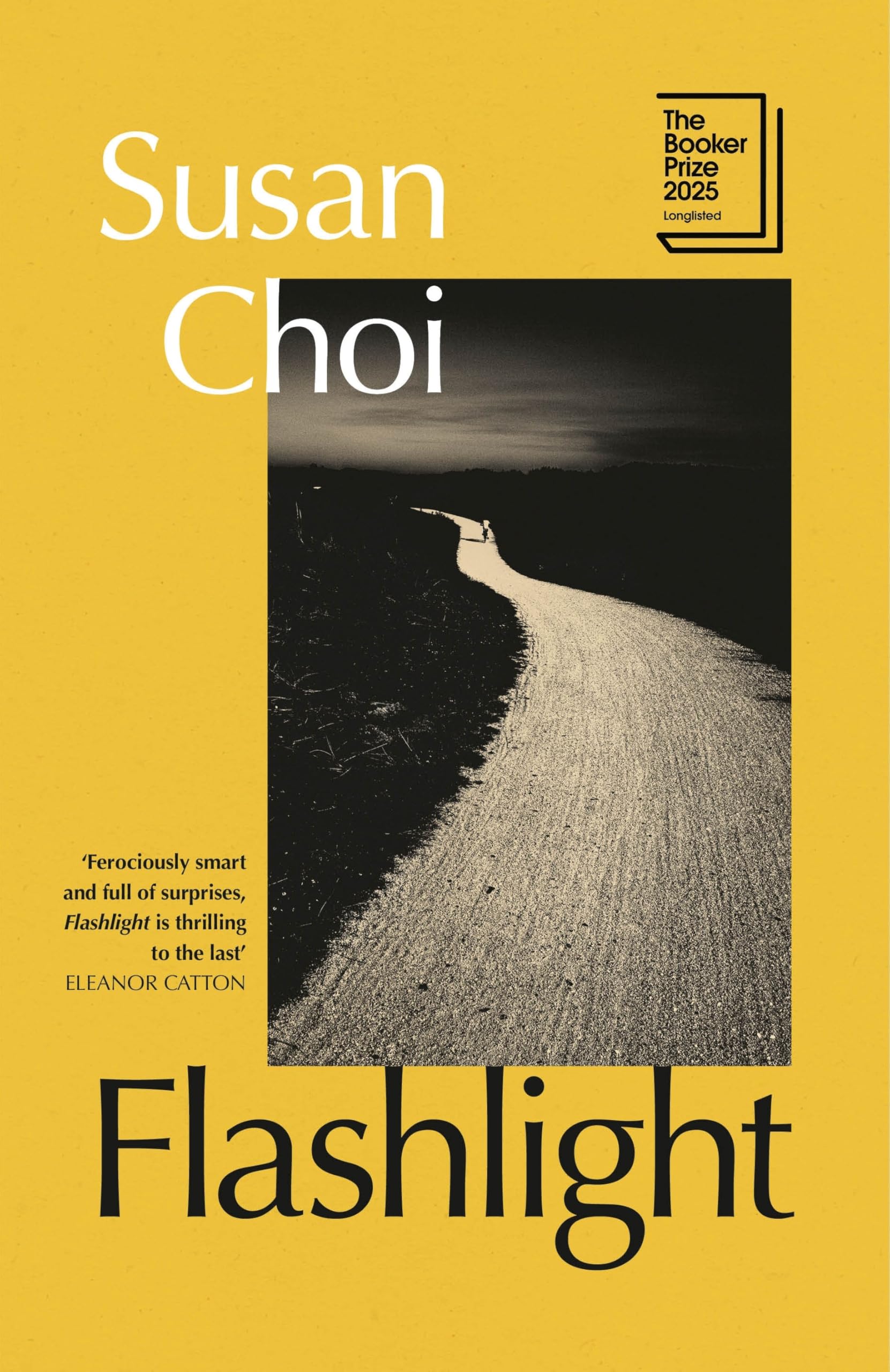
Flashlight
| Published | 2025-06-03 |
| Genre | Literary Fiction , Historical Fiction |
| Language | English |
| Publisher | Farrar, Straus and Giroux (US) |
| ISBN-10 | 037461637X |
| ISBN-13 | 978-0374616373 |
📝Honest Review
The novel begins with an absence, and that absence organizes everything that follows. Serk walks into the dark and does not come back, and for the rest of the book the question of what actually happened that night on the breakwater sits at the center of the narrative like a stone in water, sending ripples in every direction. Choi does not answer the question immediately, or simply, or with the kind of dramatic revelation that lesser novels would use as their organizing payoff. She is interested in something more interesting than an answer. She is interested in what the absence itself does to the people who are left behind, and what it reveals about the lives that led to that night.
The three point-of-view characters, Serk, Anne, and Louisa, each carry the narrative in turn, and each is rendered with a completeness that is genuinely rare. Serk is an ethnic Korean born and raised in Japan, whose family was among those scattered by the chaos of postwar Asia. His is a life defined by displacement so complete and so early that belonging itself has become unfamiliar to him. He moves through the world with the particular courtesy of a person who has never quite expected to be welcomed anywhere and has arranged his expectations accordingly. Anne is a white Midwesterner whose own past includes a teenage pregnancy, a child taken from her, and a sustained history of emotional violence that she has survived by becoming harder rather than softer. Their marriage, and the daughter it produces, is not the romantic union of two people who found each other so much as the practical arrangement of two people who found in each other a specific kind of solitude they could both live inside.
Louisa, the daughter left on the beach, is the novel's most complicated creation. She is never easy, never particularly likable, never the kind of protagonist who invites simple identification. She is prickly and difficult and occasionally infuriating, carrying grief in ways that look from the outside more like aggression than mourning. Choi never softens her or asks the reader to simply excuse her. But she makes you understand her so completely that understanding becomes its own kind of empathy, the hard-won kind that does not require a character to be lovable in order to matter.
The novel's engagement with the history of the twentieth century, particularly the chaos of postwar Japan and Korea, the division of the Korean peninsula, the way ideological contests between nations translate into the specific, irreversible disruptions of individual lives, is handled with the confidence of a writer who has done her research but knows that research exists to serve character rather than the other way around. Serk's family history, including relatives who made the disastrous decision to relocate to North Korea after the war on the promise of a better life, is woven into the novel's present with a precision that never becomes lecture and never lets you forget that the forces it describes are still producing their consequences in the world the novel inhabits.
The novel's structure, which moves backward and forward across time rather than following a linear chronology, is the right choice for the material. Each section illuminates the others in ways that a conventional timeline would not allow. Information that seems incidental in one section becomes revelatory in the next, and the experience of reading the novel is cumulative in the way that only the best ambitious fiction manages, where you arrive at the end understanding things that were in front of you from the beginning but could not be seen until the whole picture was assembled.
This is not an easy novel. It is not a comforting one. Its characters do not, for the most part, become happier or more at peace by the final pages. What it offers instead is something more durable: the sense of having truly inhabited other lives, other histories, other forms of loss, in a way that the best literary fiction can provide and nothing else quite can.
Summary:
One summer evening in 1978, in a coastal town in Japan, ten-year-old Louisa goes for a walk along the breakwater with her father Serk. He is carrying a flashlight. He cannot swim. When they do not return, people go looking. Louisa is found hours later at the water's edge, soaked and barely conscious, with almost no memory of what happened. Serk is gone, presumed drowned. That single night, and everything that comes after and before it, is what Flashlight is about. Moving across four generations and several continents, the novel traces the lives of Serk, his wife Anne, and their daughter Louisa as each of them navigates the forces that shaped them long before that evening on the beach. It is a novel about grief, about the way history moves through families without asking permission, about what it means to disappear, and about what remains in the aftermath of something no one fully understands.
✅ What I Liked
All three of the novel's central characters are rendered with the kind of psychological completeness that serious literary fiction aspires to and rarely achieves so fully. The novel's engagement with the twentieth-century history of Japan and Korea is precise and haunting without ever becoming didactic. The structural choice to move non-linearly through time serves the material beautifully, allowing each section to illuminate others in ways that build toward a genuinely affecting whole. Choi's prose is in complete command throughout, never decorative, always purposeful, and capable of the occasional sentence that stops you completely.
❌ What Could Be Better
The novel takes time to build momentum, and readers who need immediate narrative propulsion may find the early chapters slow before the full weight of what Choi is constructing becomes apparent. None of the three central characters are easy to spend time with, and while that difficulty is intentional and ultimately justified, it creates a reading experience that is more demanding than comforting. And the novel's structural complexity, while finally rewarding, requires active attention that some readers may find exhausting over 464 pages.
Discover Your Next Great Read
Handpicked recommendations from our collection of literary treasures

💬Discussions