📋 What's Inside This Guide
Most people read the wrong way. They race through pages without absorbing anything, give up on books that bore them, and then wonder why they "don't remember anything they read." The result? A shelf full of books that changed nothing, and a nagging guilt every time someone asks what they have been reading.
This guide fixes all of that. In three comprehensive sections, we cover every reading problem that beginners and experienced readers face — from retaining information after you close the book, to reading faster without losing comprehension, to taking your very first steps as a reader if you have never really had a habit. Consider this your complete operating manual for reading well.
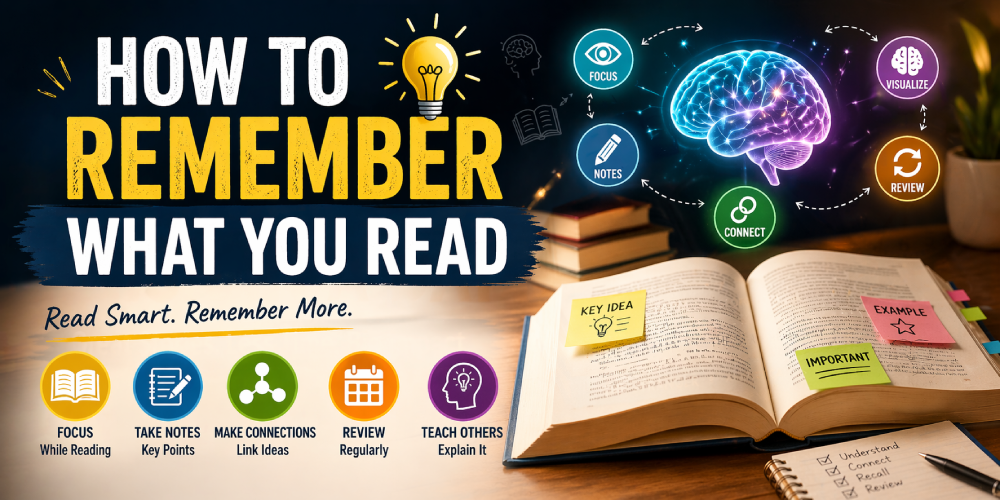
You finished the book. You enjoyed it. Three weeks later, someone asks what it was about and you can remember the cover, vaguely the main character's name, and a feeling. That is it. This is not a memory problem — it is a system problem. Your brain is not designed to store information it never uses. These eight techniques fix that by forcing your brain to engage actively with what it reads.
🔬 The Science of Forgetting (and Why It Matters)
📉
The Forgetting Curve
Psychologist Hermann Ebbinghaus found we forget 50% of new information within one hour and up to 90% within a week — without active review.
🔁
Spaced Repetition
Reviewing information at increasing intervals dramatically slows forgetting. One review the next day, one a week later, one a month later — retention jumps to 80%+.
🗣️
The Testing Effect
Studies show that retrieving information (testing yourself) is 50% more effective for long-term memory than re-reading the same material again.
🧩
Elaborative Encoding
Connecting new information to things you already know makes memories stronger, deeper, and far easier to retrieve later.
📌 How Information Actually Gets Retained
Retention depends almost entirely on what you do with information after you encounter it. Passive reading — eyes scanning words, brain on autopilot — produces almost zero long-term retention. Active engagement produces dramatically better results. Here is how different methods compare:
5%
Passive Reading
Just reading through once
10%
Highlighting
Marking text as you go
30%
Taking Notes
Writing summaries in your own words
50%
Discussion
Talking about the book with someone
75%
Teaching
Explaining concepts to others
90%
Applying It
Using ideas in real life immediately
🛠️ 8 Techniques to Remember What You Read
Passive reading is the enemy of retention. The moment you pick up a pencil — underlining, circling, writing question marks in the margin — you activate a different mode of engagement. Your brain stops being a spectator and becomes a participant. You do not need to annotate everything. Just the things that surprise, challenge, or resonate.
Try this: Write one word in the margin next to any paragraph that strikes you. Just one word. It forces you to interpret, not just receive.
📓
2. Keep a Reading Journal
After each reading session — even just 10 minutes — write 3 to 5 sentences about what you just read in your own words. Not a summary. Your reaction. What it reminded you of. What you agree or disagree with. What question it left you with. This is the single most powerful retention habit you can build.
Prompt: "The most interesting thing I read today was ___ because ___."
The Feynman Technique: if you cannot explain something simply, you have not truly understood it. After finishing a chapter or a book, explain the core idea out loud as if you are talking to a curious 12-year-old. Every gap in your explanation reveals a gap in your understanding — and forces your brain to fill it.
No one to teach? Explain it to your phone's voice recorder. Or write a tweet-length summary.
🔁
4. Review Using Spaced Repetition
Revisit your notes or highlights 24 hours after finishing a chapter, then one week later, then one month later. This exploits the spacing effect — one of the most robust findings in cognitive psychology. Each review resets the forgetting curve. Apps like Readwise automatically resurface your book highlights on a spaced schedule.
Even rereading just your underlines — not the full book — is enough to dramatically slow forgetting.
🔗
5. Connect to What You Already Know
New memories stick when they attach to existing ones. When you read something, consciously ask: "Where have I seen this before? What does this remind me of? How does this connect to something in my own life?" This process — called elaborative interrogation — is one of the most effective learning strategies in educational psychology.
Example: Reading about the Stoics? Connect their ideas about control to a moment last week when you felt anxious.
💬
6. Discuss the Book with Others
Conversation forces articulation. When you have to express your thoughts out loud to another person who may challenge or question them, your brain reorganises and deepens those ideas. Book clubs exist because social processing of information is dramatically more effective than solo processing.
No book club? Share one idea from what you are reading in a WhatsApp message to a friend. Explanation counts.
🎯
7. Set an Intention Before You Read
Before opening a book, ask yourself: "What do I want to get from this session?" One question. One goal. This primes your brain to actively look for relevant information — the way you suddenly notice every red car on the road after buying a red car. Intentional reading transforms retention from passive to active.
Write the question on a sticky note and put it on the book cover before you start reading that day.
⚡
8. Apply One Idea Immediately
The highest retention rate — 90% — comes from immediate application. When you read a useful idea, do not wait. Use it today. If you read about a morning routine strategy, try it tomorrow. If you learn a negotiation tactic, use it in your next conversation. Action cements ideas into long-term memory far more powerfully than any amount of re-reading.
Rule: For every non-fiction book, identify one idea to apply within 48 hours of finishing it.
"Read not to contradict and confute, nor to believe and take for granted, nor to find talk and discourse — but to weigh and consider."
— Francis Bacon
Speed reading promises are everywhere — "Read 1,000 words per minute!" — and almost all of them are nonsense. Research consistently shows that techniques like rapid serial visual presentation (RSVP) destroy comprehension. But that does not mean you are stuck at your current pace. The average reader reads at 200–250 words per minute. Most people can comfortably reach 350–400 without any loss of understanding. Here is how.
🚫 Speed Reading Myths vs. What Science Actually Says
❌ Myth
"You can train yourself to read at 1,000+ words per minute and still understand everything." Apps and courses promise this. It is physiologically impossible — the human eye has hard limits on how fast it can move and process text with full comprehension.
✅ Reality
Speed and comprehension trade off sharply above ~400 wpm for most people. The goal is not to read as fast as possible — it is to eliminate the bad habits that are currently slowing you down unnecessarily.
❌ Myth
"Skimming is speed reading." Skimming is a different skill for getting the gist of a text. It is not the same as reading with full comprehension at a higher speed. Treating them as the same thing leads to wasted time and zero retention.
✅ Reality
Real reading speed gains come from eliminating subvocalisation, reducing fixation points, and expanding your peripheral reading span — all learnable habits that let you read more words per eye movement without sacrificing understanding.
⚙️ 7 Habits That Are Slowing You Down Right Now
The silent inner voice that "reads aloud" in your head as your eyes scan text. Virtually every reader does this, and it caps your reading speed at roughly your speaking speed — around 150–200 wpm. You cannot eliminate it entirely, but you can suppress it. Try humming softly or counting "1-2-3" while reading. Your brain will still decode text; you are just quieting the inner narrator.
Most slow readers fixate on every single word. But your eyes can take in 4–5 words per fixation with practice. Train your eye to land in the middle of a phrase and absorb the words around it rather than jumping to each word individually. Reading in meaningful chunks — not individual words — dramatically increases speed without harming comprehension.
Unconsciously re-reading sentences you have already passed — sometimes multiple times — is one of the biggest speed killers. Studies suggest up to 30% of reading time is spent on regression. Use a finger or pen as a pacer moving steadily forward to physically prevent your eyes from drifting back. Your comprehension will not suffer as much as you fear.
Every interruption — a notification, a noise, a wandering thought — forces your brain to re-enter the text from scratch, adding cognitive overhead. A distracted reading session at 200 wpm is far slower than a focused session at 200 wpm. Protect your reading environment before trying any speed technique.
If you never consciously push your reading pace, you will always read at the same speed. Use a pacer — your finger, a pen, or even a bookmark — and move it slightly faster than comfortable. Your eyes will follow. This is called forced pacing, and it is one of the most reliably effective speed-reading techniques backed by research.
Jumping straight into a chapter without context forces your brain to build a mental map while simultaneously processing new information — which slows you down. Before reading any chapter, spend 60 seconds scanning the headings, subheadings, and any bold text. This primes your brain and makes the actual reading up to 30% faster.
Tired eyes fixate more frequently, regress more often, and decode words more slowly. The same page that takes 8 minutes at 9 PM might take 5 minutes at 9 AM. If you want to read faster, read when you are alert — morning and mid-afternoon are when most people's cognitive performance peaks.
🚀 5 Techniques That Actually Work
1
Use a Physical Pacer
Run your finger or a pen just below each line of text as you read, moving at a pace slightly faster than comfortable. Your eyes will follow. This eliminates regression and forces a consistent forward momentum. It feels awkward for the first 10 minutes. After that it becomes automatic.
✅ Start tonight: try it for one full chapter
2
Preview Before You Read
For non-fiction especially: before reading any chapter, spend 60 seconds scanning headings, the first and last paragraph, and any bold terms. This gives your brain a framework to slot new information into — which dramatically reduces processing time during actual reading.
✅ 60 seconds of preview saves 15 minutes of confusion
3
Read in Chunks, Not Words
Practise landing your eye in the middle of a 4–5 word phrase and absorbing all the words around your fixation point simultaneously. Start with 3-word chunks. Over a few weeks, expand to 5. This alone can increase your reading speed by 40–60% without any loss of comprehension.
✅ Practice: cover the left margin and read only the right side of each line
4
Vary Speed by Content Type
Not all text deserves equal speed. Race through scene-setting and description in fiction. Slow down for key arguments or emotional beats. In non-fiction, slow down for data and conclusions; speed through examples once you have grasped the point. The best readers shift gears constantly — they do not read everything at the same speed.
✅ Think of reading like driving: highways need different speed than school zones
5
Build Your Vocabulary Deliberately
Speed is also limited by how many words you need to pause and decode. The larger your vocabulary, the faster you read — because more words are instantly recognisable. Read widely across genres, keep a word list, and look up unfamiliar words the same day you encounter them. Vocabulary growth is a long-term speed investment.
✅ Learn 3 new words per week — in 12 months, you will feel the difference
"The question is not how fast you read. The question is how much of what you read becomes part of how you think."
— Goodread Editors
The biggest lie about reading is that some people are "readers" and others are not — as if it is an innate trait like eye colour. It is not. Reading is a skill and a habit, and like any skill, it is built through repetition and the right starting conditions. If you have tried to read before and failed, the book was wrong — not you.
This section is for anyone who wants to read more but does not know where to begin, has tried and quit, or feels intimidated by the idea of sitting with a book for any length of time. Start here. Follow these steps. By the end of your first month, you will be a reader.
🪜 The 10-Step Beginner's Roadmap
1
Start With What You Already Love
Forget what you think you "should" read. Forget classics, literary fiction, and the books on every "must-read" list. What topics genuinely interest you? Sports? True crime? Gaming? Business? Start there. There are excellent books on every subject. The goal right now is to find a book you actually want to open.
✅ Think: what documentary or YouTube topic could you watch for hours? Find the book version.
2
Set a Laughably Small Daily Goal
Five pages. That is all. Not 30 minutes, not a chapter — just 5 pages per day. This is small enough that on your worst day, you have zero excuse to skip it. Five pages a day is 1,825 pages a year — roughly 8 to 10 full books. The point is to build the daily identity of being "a person who reads," not to consume massive amounts of text.
✅ Tonight: read 5 pages before you check your phone in bed.
3
Own a Physical Book (to Start)
E-readers and apps are great eventually, but for beginners, a physical book has one crucial advantage: it does not have notifications. When you open a Kindle app, your phone is right there. When you open a paperback, you are just holding a book. The tactile experience — turning pages, feeling progress — is also more satisfying and reinforcing for new readers.
✅ Visit a bookshop or order one physical book this week. Make it real.
4
Put Your Phone in Another Room
This is non-negotiable. Research shows that a phone within eyesight — even face-down, even silent — reduces cognitive performance measurably. Your brain keeps monitoring it. For reading to work, especially for beginners, the phone needs to physically not be in the room. Put it in your bag, the kitchen, anywhere but where you are reading.
✅ Buy an alarm clock so your phone is no longer "needed" at bedtime.
5
Create a Reading Spot
Designate one specific chair, sofa corner, or spot that is only for reading. Not for scrolling, not for TV — just reading. Over time, sitting there will automatically trigger your brain into a reading-ready state. Add good lighting and something warm to drink. Make it a place you actually want to go.
✅ Set up your reading spot before you start your first book.
6
Give Every Book 50 Pages Before Quitting
Many great books start slowly. Give any book 50 pages before deciding it is not for you. But — and this is important — if at 50 pages you genuinely do not want to read on, put it down without guilt. Life is too short for books you hate, and forcing yourself through them is the fastest way to kill your reading habit before it starts.
✅ Abandon guilt is a superpower. The right book is waiting. Move on.
7
Stack Reading Onto an Existing Habit
New habits stick most easily when attached to existing ones. Read while your morning coffee brews. Read on your commute. Read for 10 minutes before sleep instead of scrolling. You are not finding extra time — you are replacing a lower-value activity with reading in a time slot that already exists in your day.
✅ Write down: "After I ___, I will read for 10 minutes."
8
Count Audiobooks — They Are Real Reading
If you commute, exercise, or do chores, you have untapped listening time. Audiobooks are reading. The research on comprehension between audio and visual reading is comparable for most people. Audible, Spotify, and the free Libby app (with a library card) give you access to thousands of titles. Use them without shame.
✅ Download Libby right now. It is free, and your library card unlocks everything.
9
Track Your Reading — Even Casually
Progress you can see is progress that motivates. Create a free Goodreads account and log every book you finish. Even a simple notebook where you write the title and date is enough. Seeing your list grow — even slowly — creates a powerful sense of identity. You are becoming a reader. The list proves it.
✅ Set a goal of just 6 books this year. One every two months. You can do this.
10
Tell Someone You Are Reading
Social accountability is one of the most reliable habit-formation tools available. Tell a friend what book you just started. Text someone when you finish one. Join an online book community. The social layer transforms a solo, easy-to-skip activity into something with external stakes — which makes you far more likely to show up every day.
✅ Right now: message one person and tell them what book you are starting.
📚 Best Books for Complete Beginners
These are the books we recommend to anyone starting from scratch — fast-paced, short, engaging, and almost impossible to abandon. Pick the one that sounds most like something you would actually enjoy.
😂
The Hitchhiker's Guide to the Galaxy
Douglas Adams
Laugh-out-loud funny from page one. Short chapters, ridiculous premise, impossible to put down. The perfect first book for anyone who thinks they hate reading.
~200 pages · Hilarious
🌙
The Alchemist
Paulo Coelho
Simple language, short chapters, a story that feels like it was written directly for you. Finishable in a weekend. Leaves you wanting to immediately read another book.
~160 pages · Inspiring
🔪
The Silent Patient
Alex Michaelides
A psychological thriller so gripping you will cancel plans to finish it. The "one more chapter" effect is automatic. Perfect for anyone who says they can't focus on a book.
~325 pages · Unputdownable
🧠
Atomic Habits
James Clear
Short chapters, concrete advice, immediately applicable ideas. Non-fiction that reads like a conversation. Great starter for anyone who prefers learning over storytelling.
~320 pages · Life-changing
🦁
The Lion, the Witch and the Wardrobe
C.S. Lewis
Do not let the "children's book" label fool you. This is a rich, beautifully written fantasy that adults love just as much. Short, fast, and reminds you that reading can feel like pure magic.
~180 pages · Timeless
🚀
Project Hail Mary
Andy Weir
A scientist wakes up alone in space with no memory of how he got there. Funny, clever, and relentlessly propulsive. Non-readers consistently call this the first book they have genuinely loved.
~470 pages · Addictive
✅ Your Complete Reader's Quick-Start Checklist
- Choose a book you are genuinely curious about — not one you feel obligated to read.
- Set a daily micro-goal: 5 pages or 10 minutes, nothing more.
- Create a dedicated reading spot with good lighting and zero phone.
- Stack reading onto one existing habit (morning coffee, commute, bedtime).
- Read with a pencil — underline anything that surprises or resonates with you.
- After each session, write 2–3 sentences in your own words about what you just read.
- Review your highlights or notes 24 hours after finishing each chapter.
- If a book bores you at page 50, give yourself permission to quit guilt-free.
- Tell one person what you are reading to create social accountability.
- Apply one idea from every non-fiction book within 48 hours of finishing it.
"Today a reader, tomorrow a leader."
— Margaret Fuller
Reading is not a talent. It is a practice. The gap between people who read and people who do not is not intelligence or time — it is system and habit. You now have the system. The only thing left is to open the first page.
Start tonight. Five pages. That is all it takes.
📚 Ready to Start? Browse Our Free Library
Thousands of books across every genre — fiction, non-fiction, classics, thrillers and more. Free to explore, no account required. Your next great read is one click away.
Explore the Free Library →