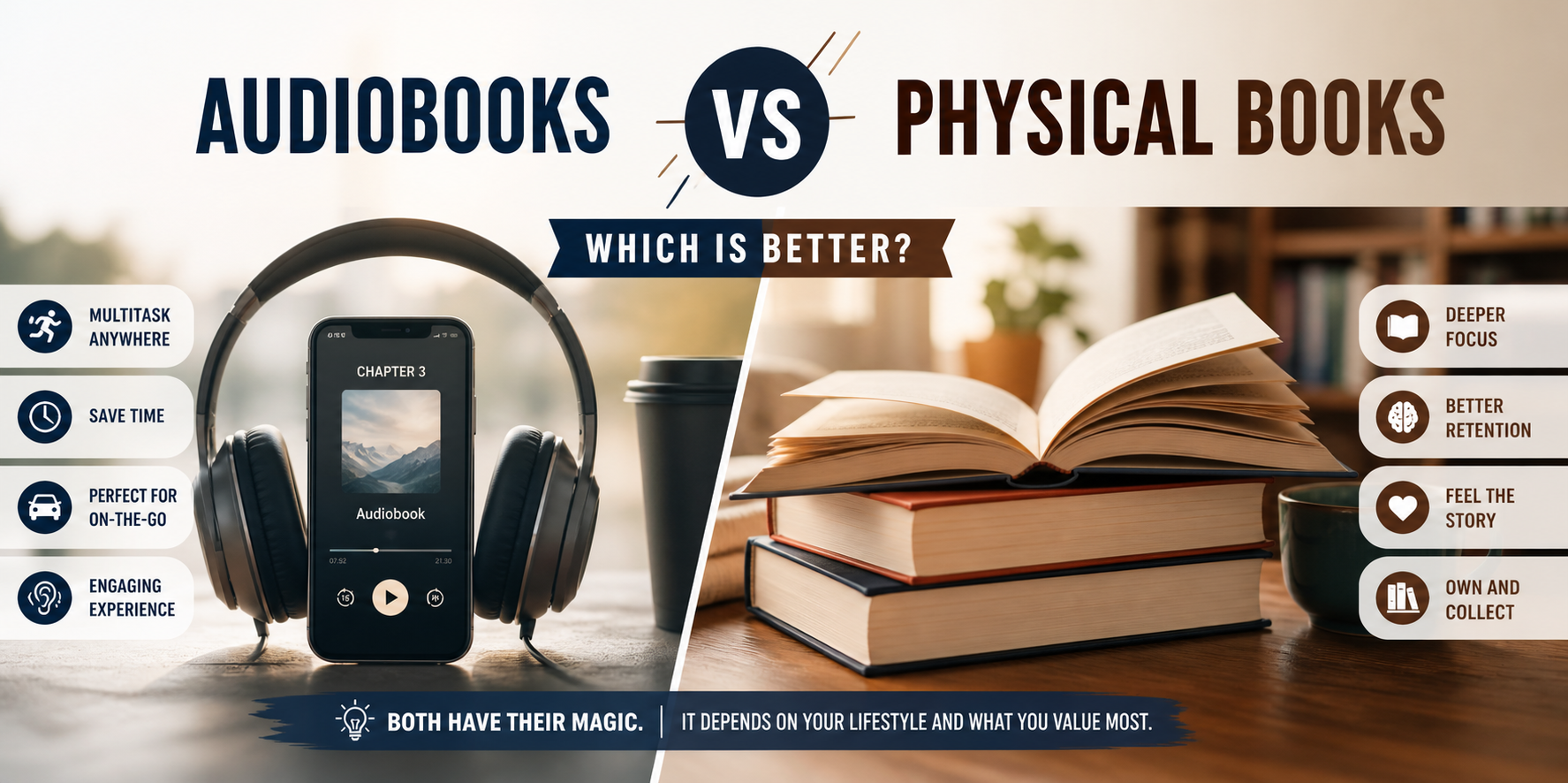
i have been going back and forth on this for years and i still do not have a clean answer. which honestly might be the most human thing i can say about it. every time i feel settled on one side i pick up something in the other format and it changes my mind again for a few weeks.
so instead of pretending there is a winner here, i want to just tell you what i have actually noticed. what each format does well, where each one falls short, and what i think is the smarter way to think about the whole question.
📖
Physical books
Best for annotation, sleep, focus
🎧
Audiobooks
Best for commutes, gym, chores
🏆
Best genres in audio
Romance, thriller, horror
📚
Best in print
Dense nonfiction, complex lit
💡
The real answer
Use both. Stop picking sides.
🆓
Free option
Libby app with library card
the thing about a great audiobook narrator is that they do not read a book to you. they perform it. and a performance of a book you love is its own kind of thing entirely.
what changed my mind about audiobooks after years of being dismissive of them
1 in 3
adults now listens to at least one audiobook a year
8hrs
average weekly listening time for regular audiobook users
14yr
consecutive years of audiobook market growth in the US
2-3x
more books read per month by people using both formats
📖 Why physical books are still the thing i reach for first
1
the tactile experience is real, not just nostalgia
there is something about a physical book that no amount of digital polish has come close to replacing for me. part of it is tactile and i know that sounds like a cliche but it is real. the weight of the thing in your hands. being able to see exactly how far through you are without thinking about it. flipping back a few pages when you missed something, which is a thing i do constantly. audiobooks make that genuinely annoying. ebooks make it slightly less annoying but still not natural.
2
i annotate and i am not giving that up
i also annotate. not extensively, but enough that losing the ability to do it cheaply and easily is a problem. i know you can highlight in apps. i do not care. writing in the margins of a physical book feels like a conversation with the text and typing a note into an app feels like filing a report.
3
reading in bed is just better without a screen
sleep is the other one. i do almost all of my serious reading in bed before i go to sleep and a physical book is just better for that. no screen. no notifications. no battery to worry about. you put it down and you fall asleep and the book sits there waiting for you. there is something quietly nice about that.
🎧 But audiobooks do things physical books simply cannot
1
they found hours you did not know you had
here is what shifted for me. i started paying attention to how much time i was spending in transit, at the gym, doing laundry, cooking dinner. hours that were just gone. and i thought, those hours could be reading hours. they could not be physical book hours because my hands and eyes were busy. but they could be audiobook hours. and suddenly i was getting through two or three more books a month without changing anything else about my life. that is not a small thing. that is actually a lot of reading. and the books i was listening to were not lesser experiences just because i was also chopping vegetables at the same time.
2
a great narrator adds something the page cannot
the narrator thing is worth stopping on for a second because it matters more than people expect. a great narrator is not reading a book to you. they are performing it. they make choices about pace and tone and emphasis that add something the author's text on its own cannot quite deliver. i listened to Demon Copperhead narrated by Charlie Thurston and there were moments where i had to stop and just sit with what i had heard because the combination of Kingsolver's writing and his voice hit harder than the page alone would have for me. that is not nothing.
3
horror in audio is something different entirely
horror is the clearest example of audio doing something print cannot. there is a version of listening to a horror story in the dark with headphones in that is genuinely more affecting than reading the same story silently. the intimacy of a voice in your ear is doing something specific to your nervous system and a good horror audiobook knows how to use that.
audiobooks did not make reading easier. they made it possible for people whose lives or bodies make traditional reading difficult. that is a much more important thing than a convenience upgrade.
⚖️ Where each one breaks down
physical books have one obvious weakness and it is time. if your life is busy and your reading windows are short and unpredictable, a physical book sitting on your nightstand is going to sit there for a while. the reading has to come to the book. you have to be still and have light and have your hands free. that is more friction than a lot of people's lives comfortably allow for.
audiobooks break down in a different way. anything with complicated structure, dense arguments, lots of data, anything where you might want to go back and re-read a paragraph three times until you understand it. those books are hard to listen to. academic nonfiction can be rough. technical writing is rough. even some literary fiction where the prose is doing something complex and you need to sit inside a sentence for a moment. audio rushes you past those sentences whether you are ready or not.
there is also the concentration problem. i lose the thread of an audiobook if i get distracted in a way i do not lose a physical book. if my mind wanders for thirty seconds while reading i just reread the paragraph. if my mind wanders for thirty seconds in an audiobook i have missed a chunk and now i have to rewind and figure out where to go back to, and sometimes i cannot quite tell, and it is just annoying enough that my attention wavers again. some people do not have this problem at all. i have it more than i would like.
📌 a quick note on whether audiobooks count as reading
research on this has been pretty consistent for a while now. comprehension and retention from audiobooks is broadly comparable to reading for most people and in some contexts listening actually produces better comprehension because the pacing is controlled by the narrator rather than the reader who might rush. the short answer is yes they count. the longer answer is that the question itself is not very interesting and you should just read or listen to whatever helps you engage with more books.
🎯 How to get the most out of both formats
the question is not which format is better. the question is which format is better for this book, right now, in this part of your day. here is how i think about it.
1
match the format to the activity, not the book
audiobooks work best when they are paired with an activity that occupies your hands and body but not your full attention. commuting, walking, cooking, cleaning, driving. physical books work best when you are still, comfortable, and not in danger of being interrupted every few minutes. once you start thinking about it this way the choice usually makes itself. you are not picking between formats. you are picking between contexts.
2
let the genre guide you
romance, thriller, and horror are usually better in audio. the intimacy of a narrator's voice does something to those genres that print cannot replicate. dense nonfiction, academic writing, anything you want to annotate or reread, that is better in print. literary fiction genuinely goes either way and sometimes it is worth trying both to see which one clicks. i found Sally Rooney harder to read than to listen to and that surprised me.
3
always sample the narrator before you commit
a great book with a bad narrator is almost unlistenable. most platforms give you five or ten minutes free before you buy. use it. if the narrator's voice or pace bothers you in the sample it will bother you for twenty hours. it is not being fussy. it is just saving yourself time. conversely a narrator you love can make a book you might have abandoned in print into something you finish happily.
4
Libby is free and most people do not know about it
if you have a public library card in the UK, US, Canada, Australia, or many other countries you have free access to Libby which is an app that lets you borrow audiobooks and ebooks from your local library at no cost. the catalogue is enormous and growing. before you sign up for a paid audiobook subscription i would always say check Libby first. it is genuinely one of the best free things available to readers right now and it is wildly underused.
5
stop treating it like you have to pick a side
the readers i know who read the most, who get through the most books in a year, are almost all using both formats. not because they are hedging. because they figured out that more formats means more time that can be reading time, and they want more reading time. the physical book is for the reading you want to sit inside. the audiobook is for the reading you want to layer into the rest of your life. both of those are real reading. both of them count.
📚 Find Your Next Book in Our Library
thousands of titles across every genre ready for you right now. no sign up needed and no cost. read it or listen to it.
Browse the Free Library →